
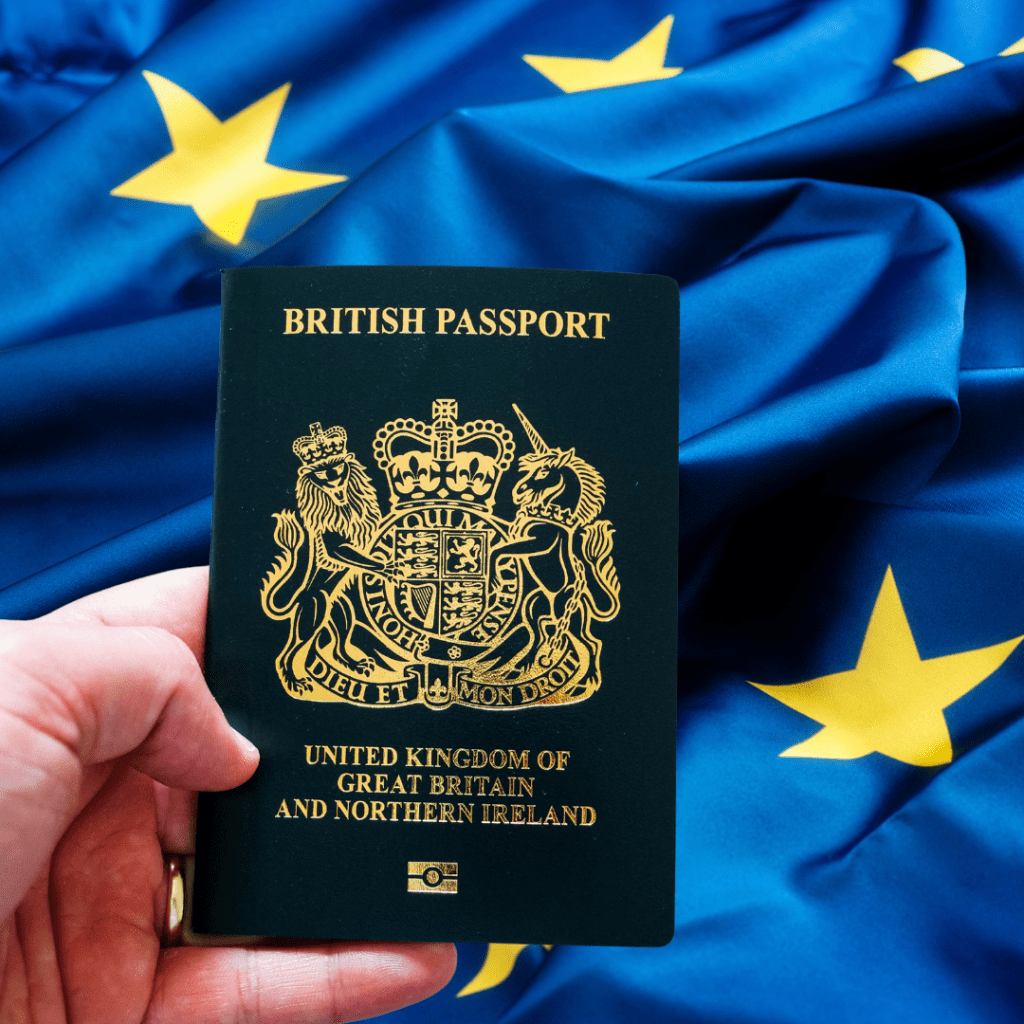
If you are a dual British–EU citizen, you do not need an Electronic Travel Authorisation (ETA) to enter the UK. This is because British and Irish citizens are exempt from ETA requirements. Once a person naturalises or registers as a British citizen, they no longer require immigration permission to enter or live in the UK, and any previous immigration status becomes void.
Proving Your Right to Enter the UK
As a dual British–EU national, you can prove your right to enter the UK with one of the following:
- a valid British passport, or
- a valid Irish passport or passport card, or
- a valid passport containing a Certificate of Entitlement.
Travelling as a Dual National: Two Sets of Rules
Dual nationals must separately prove their right to enter:
- the UK, and
- the EU.
If you live in an EU country, you may also need to show proof of your residence status to demonstrate that you are exempt from the EU’s “90 days in 180” visitor rule.
For travel, it is strongly recommended that you always carry:
- your valid British passport, and
- your valid EU passport.
You may need to show different documents at different points of your journey.
Which Passport to Use When Travelling
- From the UK to the EU:
Use your EU passport for your airline or carrier, proving your right to enter the EU. - From the EU to the UK:
Use your British passport for your airline or carrier, proving your right to return to the UK.
If you live in the EU, you may also need to show your EU passport to demonstrate residency. - At border control:
- EU border officers → show EU passport
- UK Border Force → show UK passport
Problems With Airline Systems
Many airlines do not allow passengers to attach different travel documents to different legs of a return booking. This may be purely due to limitations in their systems, but it can also be caused by front-line staff not being fully aware of the rules for dual nationals, or by airlines trying to keep their processes simple and consistent for the majority of passengers.
In practice, this may mean:
- You cannot check in online for the return journey.
- You may need to go to a check-in desk and show your British passport
In any case, airlines must accept British passports as proof that you do not need an ETA.
Ryanair Example: “You need an ETA to board” – What should you do?
If you accidentally attached your EU passport to your return flight, Ryanair (or another carrier) may wrongly insist you need an ETA.
Here is what you can do:
Option 1: Change the passport linked to your booking
Some airlines let you update your travel document mid-trip. If possible, attach your British passport once you have arrived in the EU.
Option 2: Check in at the airport
If changing the document is not possible, you may not be able to check in online.
Just go to a check-in desk and present your British passport.
If boarding is denied, the airline is incorrect and you may be entitled to compensation. Report the incident.
Airline workaround
Our experience suggests airlines sometimes refuses both options above.
Travellers have had success by:
- using Ryanair Live Chat,
- requesting that the reservation is split,
- allowing you to check in with a different document for the return leg.
Future Change: ETIAS From Late 2026
When the EU introduces ETIAS (its version of the ETA), dual nationals will need to attach different passports to each leg of a return journey:
- EU passport → flight to the EU (to avoid needing ETIAS)
- British passport → flight to the UK (to avoid needing UK ETA)
Buying separate one-way tickets is another option, though usually more expensive.
If This Affects You
Please report your experience or get in touch:
OUR DETAILS
Tel: 0330 107 0107
Email: info@imd.co.uk





 BUSINESS IMMIGRATION BLOG
Leave a comment